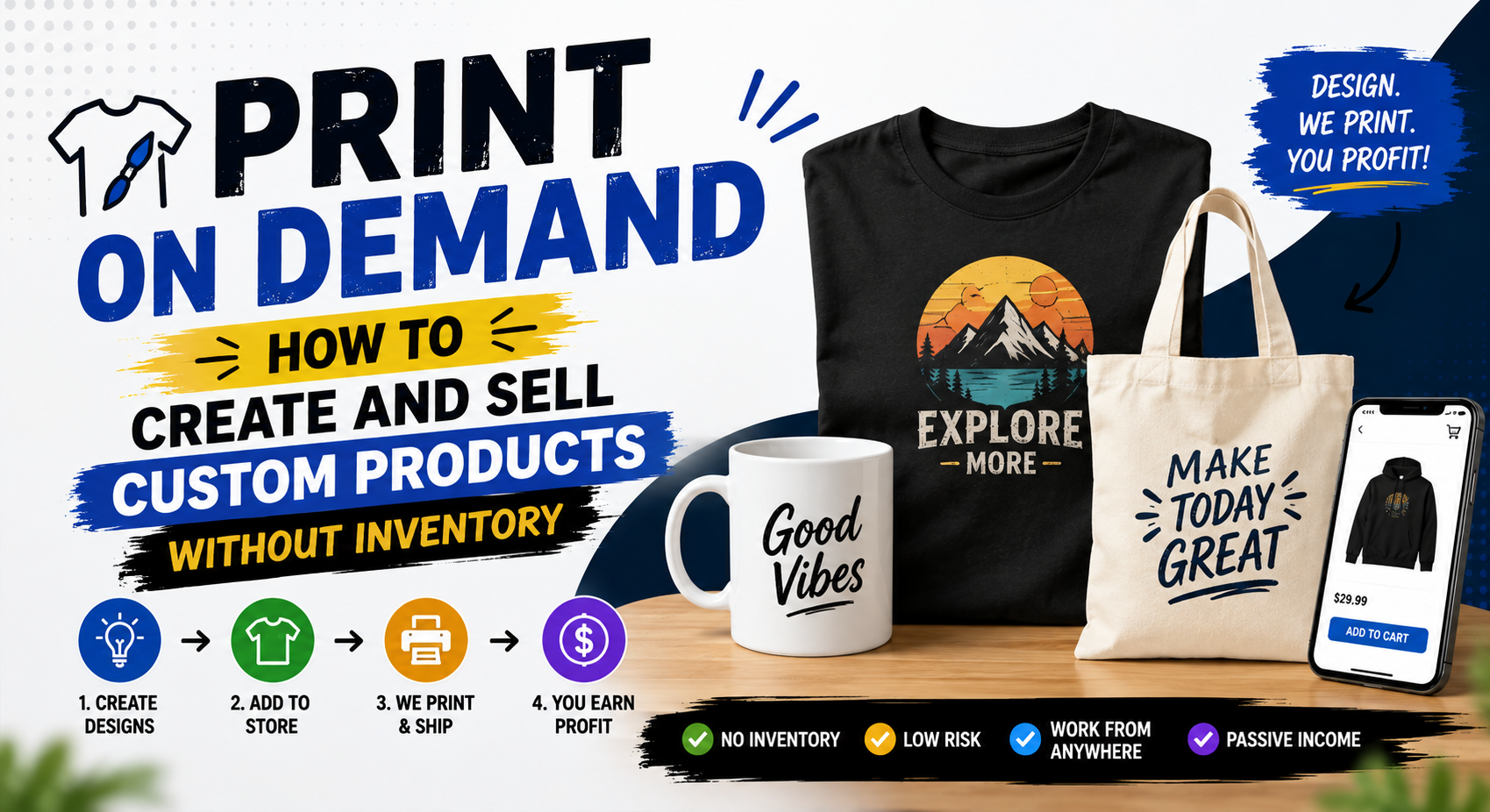

What if you could create T-shirt, hoodie, mug, sticker, or phone-case designs without buying products in bulk, renting a warehouse, or handling every customer shipment yourself?
That is the basic idea behind Print on Demand (POD).
Print on Demand is a digital business model that allows creators and designers to upload original artwork to a marketplace or fulfillment platform. When a customer orders a product featuring that artwork, the product is produced after the order is placed rather than being manufactured in advance and stored as inventory.
For beginners, this can be an attractive way to turn creativity into a potential online income stream. You can create minimalist typography, funny illustrations, motivational quotes, niche designs, seasonal artwork, or original graphics and place them on products such as T-shirts, hoodies, mugs, stickers, posters, phone cases, and more.
Tools such as Canva can make the design process accessible to people without advanced graphic-design experience. Canva provides templates and tools for creating print designs, including T-shirts, mugs, stickers, and hoodies.
Meanwhile, marketplaces such as Redbubble allow independent artists to upload designs and offer them on a wide range of products. Redbubble states that products are produced to order and shipped through third-party fulfillers, allowing artists to focus more on creating and promoting their designs.
However, Print on Demand is not simply a matter of uploading random designs and waiting for sales.
Successful POD businesses usually depend on good design, niche selection, product research, discoverability, originality, consistency, and effective promotion.
In this guide, we will explore how Print on Demand works, how to create designs with Canva, how to upload them to a platform such as Redbubble, how to choose profitable niches, how to avoid copyright problems, and how to build a sustainable POD business.
What Is Print on Demand?
Print on Demand is a fulfillment model where products are manufactured only after a customer places an order.
In a traditional retail business, you might:
- Buy products in bulk.
- Store inventory.
- Create packaging.
- Wait for customers.
- Process orders.
- Ship products.
- Handle returns.
Print on Demand changes this process.
A simplified POD workflow looks like this:
Create Design → Upload Design → Customer Finds Product → Customer Places Order → Product Is Produced → Product Is Shipped → You Receive Your Applicable Earnings
The exact process, fees, margins, payment terms, and fulfillment arrangements depend on the platform.
On Redbubble, for example, artists upload designs to products, customers purchase those products, and the products are produced to order and shipped through third-party producers.
This means you can focus primarily on the creative and marketing side rather than purchasing physical inventory in advance.
Why Is Print on Demand Popular?
Print on Demand has become popular among artists, designers, content creators, entrepreneurs, and beginners because it can reduce some of the traditional barriers involved in starting a physical-product business.
1. No Need to Buy Large Inventory
One of the biggest advantages is that you do not necessarily have to purchase hundreds of T-shirts or mugs before you know whether people want your designs.
Products can be produced after an order is placed.
This can reduce inventory risk compared with traditional merchandise businesses.
2. No Warehouse Required
You generally do not need to rent a warehouse just to store your merchandise.
The fulfillment partner handles production and shipping according to its process.
3. You Can Focus on Design
Your main responsibility can be creating original artwork and building demand around it.
This makes POD particularly appealing to people who enjoy:
- Graphic design
- Illustration
- Typography
- Digital art
- Branding
- Content creation
4. Multiple Products From One Design
A single original design can potentially be adapted to multiple products, depending on the platform's product and artwork requirements.
For example, a minimalist mountain illustration could potentially be used on:
- T-shirts
- Hoodies
- Mugs
- Stickers
- Posters
- Phone cases
Redbubble currently lists a broad range of products, including T-shirts, hoodies, stickers, posters, phone cases, and home-and-living products.
Canva: A Simple Starting Point for POD Design
If you are not an experienced graphic designer, Canva can be a practical starting point.
Canva describes itself as an online design and publishing tool designed to make visual creation accessible, including for people without professional design experience.
You can use it to create:
- T-shirt graphics
- Typography designs
- Minimalist illustrations
- Product mockups
- Stickers
- Posters
- Social media promotional graphics
- Brand assets
The goal is not to make every design complicated.
In fact, minimalist designs can work particularly well when they communicate one clear idea.
For example:
“Create. Learn. Repeat.”
A simple phrase combined with clean typography can become a merchandise concept.
The key is to create something that feels intentional and relevant to a specific audience.
What Makes a Good Print on Demand Design?
A successful POD design does not necessarily need to be complicated.
Sometimes the simplest designs are the easiest to understand.
Consider these elements:
Clear Typography
If your design contains text, make sure it can be read easily.
Avoid:
- Extremely thin fonts
- Tiny text
- Overly complicated layouts
- Too many words
A T-shirt should communicate its message quickly.
Strong Contrast
The artwork should remain visible against the product color.
A dark design on a black shirt may not be effective unless the design is intentionally built for that combination.
Balanced Composition
Avoid placing everything in one corner.
Think about:
- Spacing
- Alignment
- Visual hierarchy
- Proportion
Original Concept
Do not simply copy popular designs.
Try to develop your own visual identity.
Choose a Niche Before Creating Hundreds of Designs
One of the biggest mistakes beginners make is designing random products for everyone.
Instead, choose a niche.
A niche is a specific audience or interest group.
Examples include:
- Cat lovers
- Dog owners
- Coffee enthusiasts
- Fitness enthusiasts
- Gamers
- Programmers
- Teachers
- Nurses
- Students
- Travelers
- Book lovers
- Gardeners
- Photographers
- Freelancers
- Entrepreneurs
Imagine creating a store specifically for coffee lovers.
Instead of random designs, your catalog might include:
- “Coffee First, Everything Else Later”
- Minimal coffee cup illustrations
- Funny coffee-related typography
- Morning coffee designs
- Coffee and productivity concepts
Your store becomes easier to understand.
Why Niche Marketing Matters
Suppose you create 100 random designs.
One is about cats.
Another is about football.
Another is about cooking.
Another is about programming.
Another is about travel.
Another is about motivation.
There is no clear identity.
Now imagine creating 100 designs for programmers.
Your entire store becomes relevant to one audience.
You can create designs around:
- Coding jokes
- Programming languages
- Developer culture
- Debugging
- Software development
- Tech humor
- Developer lifestyle
A focused niche can help you build a more recognizable creative identity.
Research Your Niche Before Designing
Before creating dozens of products, research what your audience likes.
Look at:
- Search suggestions
- Marketplace categories
- Popular product themes
- Social media conversations
- Seasonal interests
- Common jokes
- Frequently discussed problems
- Audience demographics
But research should inspire ideas, not encourage copying.
Ask:
What does this audience care about?
What type of humor do they enjoy?
What visual styles are common?
What products might they actually wear or use?
The objective is to identify opportunities for original concepts.
Create Minimalist T-Shirt Designs
Minimalist T-shirts are often based on a small number of visual elements.
A minimalist design might contain:
- One phrase
- One symbol
- Two fonts
- A simple illustration
- Limited colors
- Plenty of negative space
For example, a travel-themed shirt could use:
“Take the Scenic Route.”
with a simple line-art mountain.
The design does not need dozens of graphics.
The message is the product.
Create Hoodie Designs
Hoodies offer a larger canvas than many standard shirt placements.
You can experiment with:
- Center graphics
- Small chest logos
- Large back designs
- Sleeve concepts
- Typography
- Illustrations
Think about how the design will look when someone is actually wearing the hoodie.
A design that looks impressive on a computer screen may not look good on clothing.
Always preview the design on the actual product mockup before publishing.
Create Coffee Mug Designs
Mugs provide a different design opportunity.
People often buy mugs based on:
- Humor
- Personality
- Occupation
- Hobbies
- Quotes
- Gifts
- Lifestyle
Examples of niche ideas include:
For teachers:
“Powered by Coffee and Patience”
For programmers:
“Code. Coffee. Debug. Repeat.”
For book lovers:
“One More Chapter.”
The important thing is to avoid generic content when possible.
Make your concept specific to your audience.
Create Designs for Gifts
Gift-related POD products can be especially useful because buyers are often searching for something that represents another person's personality or interests.
Potential themes include:
- Birthday gifts
- Graduation
- Father's Day
- Mother's Day
- Teacher gifts
- Wedding gifts
- Anniversary gifts
- Friendship gifts
- Career-related gifts
However, seasonal designs should be planned ahead.
Do not wait until a holiday is already happening.
Create and publish seasonal designs early enough to allow discovery and purchasing.
Design With the Final Product in Mind
One of the most important POD lessons is:
A design that looks good digitally does not automatically look good on a physical product.
Redbubble recommends paying attention to product-specific formatting, dimensions, placement, and color. Different products can require different approaches.
For example:
A design that looks excellent on a T-shirt may not work well on a mug.
A detailed illustration may look great on a large poster but become difficult to read on a small sticker.
Therefore, preview your design carefully.
Pay Attention to Image Quality
Low-resolution artwork can create disappointing printed results.
Start with a high-quality design file rather than attempting to enlarge a small image later.
Redbubble specifically recommends starting with a sharp, high-quality file because enlarging a low-resolution file can result in blurry details.
Before uploading, check:
- Pixel dimensions
- File format
- Transparency
- Edges
- Text readability
- Image sharpness
Always check the platform's current requirements before uploading because specifications can change.
Be Careful With Transparent Backgrounds
Transparent backgrounds can be particularly useful for merchandise designs.
For example, suppose you create a white coffee cup illustration with no background.
A transparent PNG can allow the artwork to sit naturally on different product colors.
But transparency is not appropriate for every design.
A full-background illustration may require a different file approach.
Think about the final product rather than simply exporting the design.
Understand Print Limitations
Digital screens can display colors and details differently from physical printing.
Redbubble notes that highly saturated or neon colors may not reproduce exactly as they appear on screen, and very fine details or thin lines can be difficult to reproduce clearly.
Therefore:
- Avoid extremely tiny text.
- Avoid ultra-thin lines.
- Test strong color combinations.
- Use clear shapes.
- Check the product preview carefully.
Designing for print is different from designing only for a screen.
Upload Your Designs to Redbubble
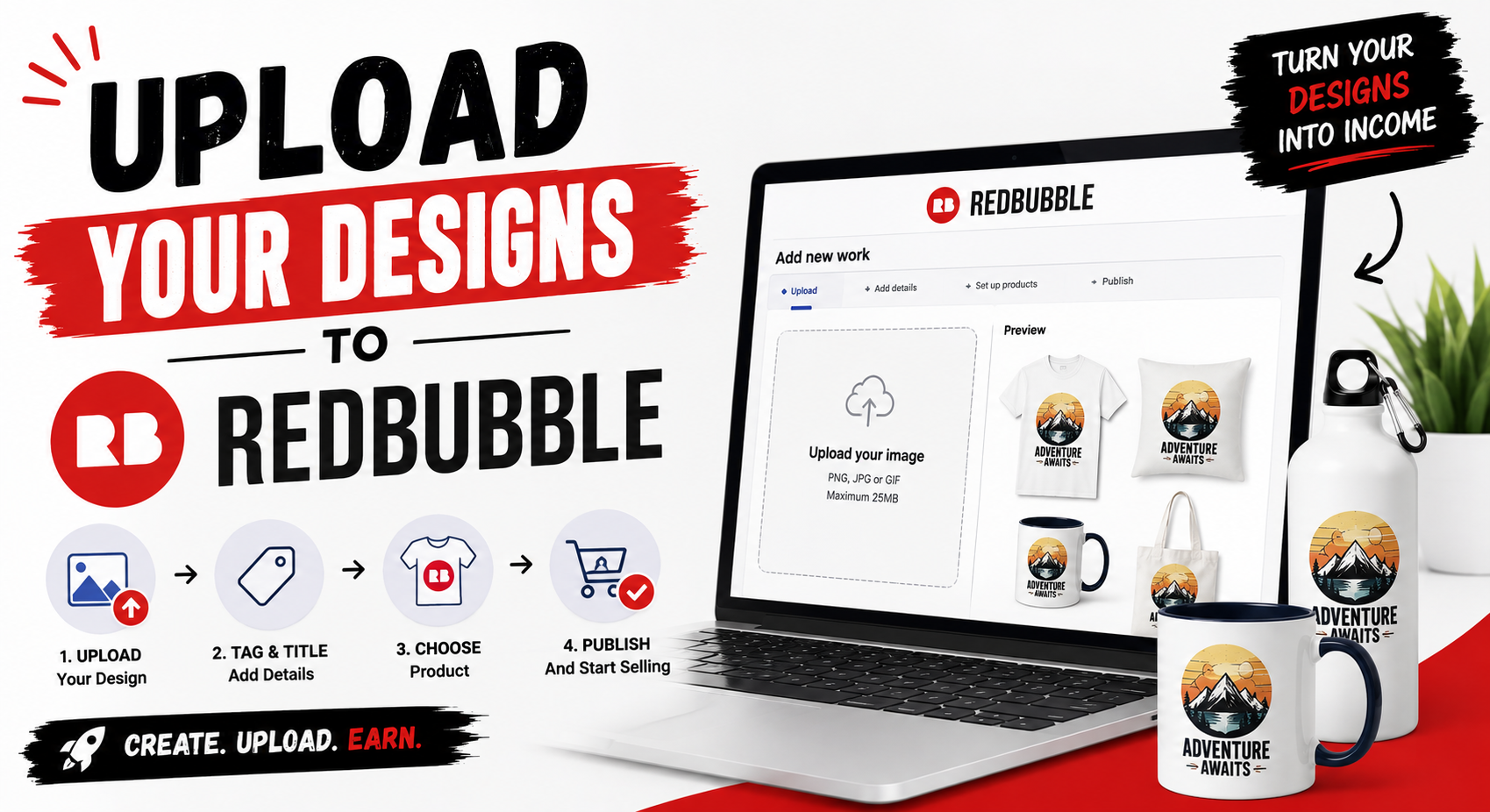
Once your artwork is ready, you can upload it to a marketplace such as Redbubble.
The general workflow is:
Create Account → Upload Artwork → Apply Artwork to Products → Adjust Placement → Add Product Information → Publish
Redbubble allows artists to upload artwork and customize how it appears across available products.
Do not simply upload a file and immediately publish everything without checking.
Review each product.
Ask:
- Is the artwork centered?
- Is it too large?
- Is it too small?
- Does the color work with the product?
- Is the text readable?
- Does the design look professional?
Small adjustments can significantly improve presentation.
Write Better Product Titles
Your product title should explain what the design is about.
Instead of:
“Cool Shirt Design 01”
consider something more descriptive, such as:
Minimalist Coffee Lover T-Shirt – Funny Coffee Typography Design
The title should be natural and relevant.
Do not fill titles with unrelated keywords.
Search optimization works best when your metadata accurately describes the product.
Use Relevant Tags
Tags can help marketplaces understand what your design represents.
For a minimalist coffee design, relevant concepts might include:
- Coffee lover
- Coffee gift
- Minimalist coffee
- Coffee humor
- Cafe lover
- Coffee addict
- Barista gift
Avoid irrelevant tags.
If your design is about coffee, adding unrelated terms such as “gaming,” “football,” and “travel” simply to gain visibility can reduce relevance and create a poor user experience.
Write Useful Product Descriptions
A good description can explain:
- The design concept
- The intended audience
- The occasion
- The product's theme
- Potential gift recipients
For example:
“A minimalist coffee-themed design created for people who believe that the best mornings begin with a fresh cup of coffee. A simple gift idea for coffee lovers, cafe enthusiasts, and anyone who takes their morning brew seriously.”
The description should sound natural.
Understand Your Artist Margin
Print on Demand does not mean every sale becomes pure profit.
The marketplace typically has costs associated with manufacturing and operating the platform.
On Redbubble, artists can select a percentage markup above the applicable base amount, which contributes to the artist's margin. The platform also has account-tier and fee rules that can affect earnings, so creators should check the current pricing and fee information before making business decisions.
This means you should not simply think:
Selling Price = Profit
Instead, understand the platform's current calculation.
Your actual earnings may depend on:
- Base price
- Your selected markup
- Platform fees
- Account tier
- Discounts
- Taxes where applicable
- Other marketplace terms
Always review the current platform policies.
Do Not Expect Instant Sales
One of the biggest misconceptions about Print on Demand is that uploading designs automatically generates income.
It does not.
There are millions of designs competing for attention.
A new store may have:
0 sales → 0 sales → 0 sales → first sale → more testing → more sales
This is normal.
You need to build a catalog and learn what your audience responds to.
Create More Than One Design
A single design is unlikely to create a sustainable business.
Instead, build a catalog.
For example:
Month 1
Create 20–30 designs.
Month 2
Create another 20 designs based on your strongest ideas.
Month 3
Experiment with new styles and related niches.
The goal is not to create low-quality designs quickly.
The goal is to develop a consistent library of original, useful, marketable artwork.
Redbubble has previously recommended building a catalog and adding new artwork regularly, emphasizing that successful artists often keep their stores fresh.
Use One Idea Across Multiple Products
Suppose you create:
“Powered by Coffee”
Instead of using it only on a T-shirt, you could adapt the concept to:
- Hoodie
- Mug
- Sticker
- Phone case
- Notebook
- Poster
This does not mean blindly placing every design on every product.
Consider which products make sense for the concept.
A coffee quote may naturally fit a mug.
A large illustration may work better as a poster.
A wearable slogan may work better on apparel.
Promote Your Print on Demand Store
Marketplace discovery can help, but external promotion can also be valuable.
You can promote your designs through:
- TikTok
- YouTube
- Blogs
- Email newsletters
- Niche communities
For example, if you create products for book lovers, you can create social content around:
- Reading quotes
- Book recommendations
- Reading habits
- Cozy reading setups
- Gift ideas for readers
Then introduce your relevant merchandise naturally.
Create Content Around Your Niche
Content marketing can help you attract people who are interested in your audience rather than simply people looking for products.
Imagine you sell products for programmers.
You could create content such as:
“10 Funny Things Every Programmer Understands”
“Best Gifts for Software Developers”
“Why Programmers Love Coffee”
Then your products become part of a larger content ecosystem.
This can be more effective than repeatedly posting:
“Buy my T-shirt.”
Build a Recognizable Brand
If you want to turn POD into a long-term business, think beyond individual designs.
Create a recognizable visual identity.
Consider:
- Store name
- Logo
- Typography
- Design style
- Color palette
- Target audience
- Brand voice
For example, your entire store could follow a minimalist black-and-white aesthetic.
Another store might specialize in colorful cartoon illustrations.
Consistency can make your products feel like they belong to the same brand.
Avoid Copyright and Trademark Problems
This is one of the most important parts of Print on Demand.
Do not assume that something available online is free to use.
Avoid using:
- Movie characters
- Celebrity images
- Sports team logos
- Company logos
- Brand names
- Copyrighted artwork
- Popular characters
- Trademarked slogans
unless you have the necessary rights or permission.
Redbubble's user agreement makes clear that sellers are responsible for ensuring that their content does not violate intellectual-property rights or other laws.
Create original artwork or use assets under licenses that actually permit the intended commercial use.
Be Careful With AI-Generated Designs
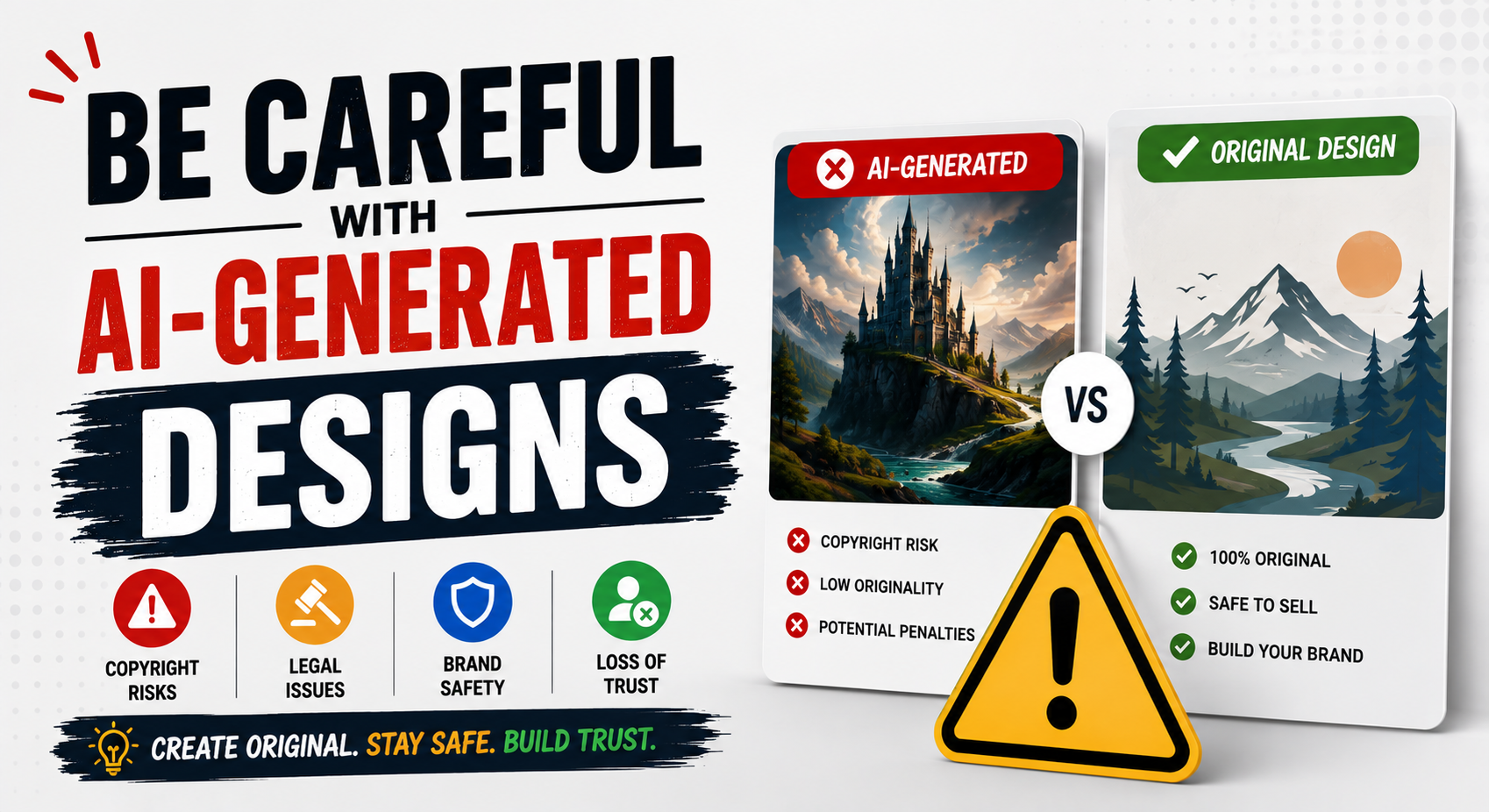
AI tools can help with brainstorming and creative workflows, but you should still understand the platform rules and applicable rights surrounding any assets you use.
Do not assume that generating an image automatically gives you unrestricted commercial rights in every circumstance.
Before uploading an AI-assisted design:
- Check the tool's current terms.
- Check the marketplace's rules.
- Avoid recognizable copyrighted characters.
- Avoid trademarks.
- Review the output for unwanted similarities.
- Add genuine creative contribution where appropriate.
Your responsibility as a seller is to ensure that the content you upload is suitable for commercial use.
Track Which Designs Perform Best
After publishing your products, pay attention to performance.
You can learn from:
- Views
- Favorites
- Sales
- Product types
- Niche categories
- Design styles
- Seasonal trends
Suppose your minimalist programmer designs consistently outperform your generic motivational designs.
That is useful information.
Create more original designs for the audience that is responding.
This is how your store evolves based on evidence rather than guesswork.
Create Collections
If your platform supports suitable organization, group related designs into logical themes.
For example:
Coffee Collection
Programming Collection
Teacher Collection
Minimalist Quotes Collection
Travel Collection
This can make your catalog easier for customers to explore.
Build Seasonal Collections
Seasonal events can create additional opportunities.
Examples include:
- New Year
- Valentine's Day
- Graduation season
- Father's Day
- Mother's Day
- Halloween
- Christmas
- Back-to-school season
But remember that seasonal competition can be high.
Start designing early.
Create original concepts rather than copying common designs.
A Simple 30-Day Print on Demand Plan
If you are completely new to POD, you can use a simple 30-day experiment.
Week 1: Choose Your Niche
Research three potential niches.
Select one based on:
- Personal interest
- Audience size
- Competition
- Design opportunities
- Product relevance
Week 2: Create Designs
Create 10–15 original designs.
Experiment with:
- Typography
- Illustrations
- Minimalism
- Different layouts
Week 3: Publish
Upload your best designs.
Optimize:
- Titles
- Descriptions
- Tags
- Product placement
- Mockups
Week 4: Promote
Share your products through relevant social channels.
Study which designs receive attention.
Then use those insights to create your next batch.
Common Print on Demand Mistakes
Mistake 1: Copying Popular Designs
Copying may create copyright and trademark problems and does not build a sustainable brand.
Better approach: Develop original concepts.
Mistake 2: Using Low-Resolution Images
Poor-quality files can produce poor physical prints.
Better approach: Start with high-quality artwork.
Mistake 3: Choosing a Huge Niche Without Differentiation
“Funny T-shirts” is extremely broad.
Better approach: Focus on a specific audience.
Mistake 4: Uploading Random Products
A store without a clear identity may be difficult to remember.
Better approach: Build collections around a niche.
Mistake 5: Ignoring Product Mockups
A design can look different when placed on an actual product.
Better approach: Review every product preview.
Mistake 6: Expecting Instant Passive Income
POD requires experimentation, design work, marketing, and patience.
Better approach: Treat it like a real digital business.
Mistake 7: Ignoring Platform Fees
Revenue is not the same as profit.
Better approach: Understand the platform's current fee and margin structure.
Is Print on Demand Really Passive Income?
Print on Demand can become semi-automated, but calling it completely passive can be misleading.
After your design is published, the platform may handle much of the production and fulfillment process. But you still need to:
- Create designs
- Research niches
- Upload products
- Optimize listings
- Promote your store
- Respond to issues where required
- Monitor performance
- Update your catalog
The more successful your store becomes, the more strategic work may be required.
Think of POD as a low-inventory digital commerce model, not guaranteed passive income.
How to Make Your Print on Demand Business More Profitable
Profitability depends on several factors.
Focus on these areas:
Better Designs
Improve your visual quality.
Better Niches
Target audiences with clear interests.
Better Product Selection
Place designs on products where they make sense.
Better SEO
Use relevant titles, descriptions, and tags.
Better Promotion
Reach your audience outside the marketplace.
Better Testing
Create multiple designs and learn from results.
Better Branding
Build a recognizable store rather than a collection of unrelated products.
Final Thoughts
Print on Demand has made it easier for independent creators to experiment with merchandise without necessarily investing in large amounts of physical inventory.
With a design platform such as Canva, beginners can create T-shirt graphics, mug designs, hoodie artwork, stickers, posters, and other visual products without needing advanced graphic-design software.
A marketplace such as Redbubble can then provide a way to display those designs on physical products, with products produced to order through third-party fulfillers and shipped to customers according to the marketplace's fulfillment process.
But the technology is only the beginning.
Your real advantage comes from creativity, originality, niche knowledge, and consistency.
Do not simply create hundreds of random T-shirts.
Choose an audience.
Understand what they enjoy.
Create designs that speak to them.
Make sure your files are high quality.
Write accurate product information.
Use relevant tags.
Promote your work.
Study your results.
Then create more of what works.
A simple design can become a successful product when it connects with the right audience.
The opportunity is not just to put artwork on products.
The opportunity is to build a recognizable creative brand around a specific community.
That is what can turn Print on Demand from a simple design experiment into a serious long-term online business.
Frequently Asked Questions About Print on Demand
1. What is Print on Demand?
Print on Demand is a business model where products are manufactured after a customer places an order rather than being produced and stored as traditional inventory in advance.
2. Can I start Print on Demand with Canva?
Yes, Canva provides tools and templates for creating various print designs, including T-shirts, mugs, stickers, and hoodies. Always check the current licensing terms for any assets you use commercially.
3. Does Redbubble print and ship products?
Redbubble states that products are produced to order and shipped through third-party producers, while the marketplace facilitates the process for artists.
4. Do I need to buy T-shirts before selling them?
In a typical Print on Demand model, you do not need to purchase a large inventory of blank products in advance. Products are generally produced after customer orders are placed.
5. How much money can I make with Print on Demand?
There is no guaranteed income. Earnings depend on factors such as design quality, product demand, marketplace visibility, pricing, fees, niche selection, and marketing.
6. Is Print on Demand free to start?
Some platforms allow creators to open stores without an upfront inventory purchase, but fees, account tiers, service charges, transaction costs, or other conditions may apply. Always check the platform's current terms.
7. What should I sell with Print on Demand?
Popular product categories can include T-shirts, hoodies, mugs, stickers, posters, phone cases, and other merchandise. Choose products that make sense for your specific design and audience.
8. Can I use copyrighted characters on POD products?
You should not use copyrighted characters, trademarks, logos, or other protected content without the necessary rights or permission. Sellers are responsible for ensuring that their content complies with intellectual-property laws and marketplace rules.
9. Are minimalist designs good for Print on Demand?
They can be. Minimalist designs can work particularly well when the message is clear, the typography is readable, and the artwork is properly adapted to the physical product.
10. How do I get my first Print on Demand sale?
Start by choosing a focused niche, creating original designs, publishing a useful catalog, optimizing your product listings, and promoting your work to the relevant audience. There is no guaranteed method or timeline for a first sale.
SEO Keywords
Primary Keyword: Print on Demand
Secondary Keywords:
- Print on Demand business
- Print on Demand for beginners
- how Print on Demand works
- how to start Print on Demand
- Print on Demand with Canva
- Redbubble Print on Demand
- sell T-shirt designs online
- sell custom products online
- Print on Demand business ideas
- Print on Demand without inventory
- how to sell designs online
- Canva T-shirt design
- minimalist T-shirt designs
- Print on Demand passive income
- Redbubble selling tips
- Print on Demand products
- custom merchandise business
- online T-shirt business
Suggested SEO Meta Title
Print on Demand: How to Create & Sell Custom Products Without Inventory
Suggested Meta Description
Learn how to start a Print on Demand business using Canva and platforms like Redbubble. Discover how to create designs, choose niches, optimize products, and sell custom merchandise online.
Suggested URL Slug
/print-on-demand-business/
Suggested Featured Image Title
Print on Demand: Create Designs, Sell Products & Earn Without Inventory